

EDIT Fall 2021:
Once it became clear that the56° Nord roof box wouldn'tbe comingto market, we decided to design our design our own roof box. It’s designedto withstandhigher speeds and places a strongemphasis on aerodynamics and design. And after two years of development, we’ve finally succeeded: the development of aroof box for sports cars. Built for coupes, sedans, station wagons, and SUVs.
We are pleased to announce that youcannow order . The first generation will be shipped in the fourth quarter of 2022 andwillinitiallybelimited to arun of just100 units. So act fast—the first roof boxes have already been pre-ordered.
We spent over a year testing various roof boxes. We weren't really satisfied with any of them, since while individual features were often good, the overall package left something to be desired.
Our criteria were an attractive design, light weight, approval for speeds over 130 km/h, and pleasant wind noise.
We’ve already published a few blog posts on this topic, but they’ve since been moved to the archive. Nevertheless, we’d like to share the findings with you in this brief post and raise awareness of the topic to save you the trouble of doing extensive research.
Things look different in photos than they do in real life
The first thing we noticed were the edited photos and illustrations used to make the roof boxes look as harmonious as possible with the vehicles. As a result, the boxes always look really good—until you see them on your own car, which may not be modified.
Roof Box Design vs. Automotive Design
Many roof boxes are designed by designers who either reject current automotive design trends or are unfamiliar with automotive design.
As a result, many cars feature pronounced creases and edges, which were last seen in automotive design in the early 2000s.
At the moment, however, we believe a clean and uncluttered design is more appropriate—without tunnels, ridges, edges, spoilers, etc.
The clean design is (based on our own experience from the development process) much more challenging, since every line has to be just right.
Basically, a roof box shouldn't look like a foreign object on the car. It's really not easy, but it can be done!
Proximity to the car
Following up on the previous point, the speakers always appear very close to the car in photos. It just looks sportier. But if they’re actually very close to the car in real life, this can even lead to problems. We ourselves always wanted to have our test boxes as close to the car as possible and tested various mounting brackets. Visually, it does indeed look a bit sportier. However, there are two major drawbacks: the box bangs against the car’s roof when it’s loaded, or “sways” when it’s empty. This causes lots of small scratches.
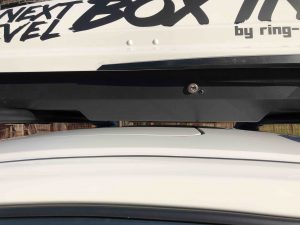
The box is too close to the car, which causes scratches and impairs aerodynamics
Another problem we’ve identified is aerodynamics: there’s a buildup of air in front of the box, and no air is passing under it anymore. This becomes apparent when you don’t have a rear windshield wiper and have to rely on the airflow. This would be manageable if it weren’t for the rear spoiler—or rather, the car’s own aerodynamics: When airflow no longer reaches the rear of the car, the cars experience aerodynamic problems related to downforce.
During a phone call with a development engineer at Porsche, we also received confirmation that this is one of the reasons why they make sure there is always enough airflow between the tire and the car. Performance, therefore, takes precedence over design.
However, our approach allowed us to resolve this conflict of objectives. We deliberately designed the lines to “move away from the car” in order to ensure perfect aerodynamics while maintaining a truly excellent overall design of both the car and the pit.
Roof boxes are meant to be opened
 As silly as it sounds, one of the key features of roof boxes currently works only very rarely: opening and closing without any trouble. The rather small key often has to be maneuvered into the keyhole first. After that, most models require quite a bit of force to move the internal rail, which led us to hesitate about stowing luggage in the roof box during a winter trip—the risk of the key breaking was simply too great for us.
That aside, once the roof box is unlocked, the biggest drawback for us—with nearly every model—is opening the top half. Due to the materials and design, the top half starts to warp. The hinges that allow it to open on both sides seem overburdened, and overall, everything just feels very wobbly.
We believe that a roof box should be as easy to open as a trunk lid.
The background noise
Admittedly, the Porsche 911 chassis and the minimal sound insulation reveal nearly every noise coming from items inside or on the car.
The same was true for roof boxes. As a result, nearly all of the boxes rattled audibly at low speeds and produced quite a bit of wind noise on the highway.
For a low-budget product, that would be acceptable. However, we tested some higher-priced speakers and feel that there’s definitely room for improvement here.
The weight should not be underestimated
The first thing people often compare is the weight of a roof box. This is actually very important for the following reasons:
- You can load more
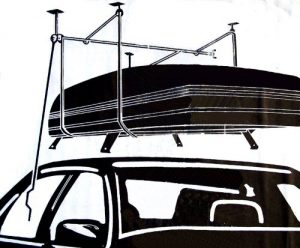
For some models, you'll need a roof box lift or several people (Image source: ATU)
- The standard roof load capacity is 75 kg, and if the box and base rack already weigh 35 kg, that leaves less payload capacity.
- The car's high center of gravity is reduced
- When it's loaded, the center of gravity is negligible anyway, but you often drive with an empty box and come to appreciate having a lightweight box on the car
- The car's total weight is reduced with a lightweight body
- Anyone who wants to save fuel or energy, enjoys taking advantage of the car's dynamic capabilities, and also wants to come to a stop quickly when braking places a high value on the car's low overall weight
- Often Underestimated: Installing and Removing the Box
- There were a few test boxes that could only be carried by two people. As a result, there were times when the box was moved around unnecessarily because it couldn't be moved by one person alone.
The Topic of Speed
How fast are you actually allowed to drive with a roof box?! Exactly. 130 km/h. For virtually every model we know of, the manufacturer recommends 130 km/h. Often, the instructions note that “you could go faster, though.” But if something happens, the manufacturer cites the 130 km/h limit and thus avoids liability.
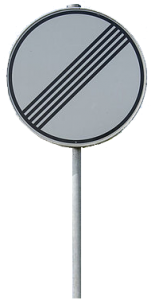
But for us, the topic was also important for another reason: a 911 simply doesn't like to drive at 130 km/h all the time.
A comfortable cruising speed—which is quite achievable in some sections of the highway—is 170 km/h. This is also reflected in the feedback we received from BMW, Audi, Mercedes, and Volkswagen drivers: “We want to drive faster when traffic allows.”
Although a general speed limit for Germany has been discussed before, what stands out here is the idea that “if I wanted to, I could.” Just as is generally the case with driving: the idea that you can actually go anywhere at a moment’s notice isn’t restricted by speed limits. Just as sports cars sell well in Switzerland despite very strict speed limits there, roof boxes, too, should—at least to some extent—not restrict your car too much and should reflect that sense of freedom.
We received a fitting comment in response to a query on our blog back then, which sums up driving with a standard roof box quite well: “The moment I put a roof box on my car, it turns my Audi A6 into a truck—slow, aerodynamically inefficient, unstable, and unattractive. Just the thought that I can’t drive faster than 130 bothers me.”
Speeds of up to 300 km/h—as demonstrated by a carbon-fiber prototype—are, incidentally, indeed possible. However, this comes at the expense of the box’s overall weight, since stability and weight are often at odds with one another.
For us, the right balance is key. The main focus of our roof box isn’t to reach 300 km/h. Rather, it should be able to withstand a lap on the Nordschleife, where high (lateral) dynamic values—caused by tight, high-speed corners and heavy acceleration and braking—are crucial. On the Döttinger Höhe (long straight), you could then put the box to the test in terms of top speed.
Summary
We really tested everything and were open to all manufacturers and their promises. But we were never truly convinced. So, if there’s a problem, we should work on a solution. We took on the challenge and are developing the perfect roof box for some people. The ones that already exist aren’t bad by any means, but there’s always room for improvement if you don’t want to compromise.