
Essentially, two major driving resistances prevent us from traveling at infinite speed: rolling resistance (FRoll) and air resistance (FLuft). These are two forces that act against the vehicle’s propulsive force on a flat road and effectively slow the car down.
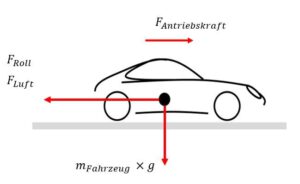
Source: Wikipedia (https://bit.ly/2EVmSyR)
The effect of these types of resistance depends heavily on the speed at which you’re driving. If you’re traveling at about 30 km/h, rolling resistance accounts for about 90% of the total resistance, while aerodynamic drag accounts for only about 10%. So you could even drive with a wall unit on the roof of your car and your fuel consumption wouldn’t be significantly higher—provided the wall unit is lightweight.
At a speed of approximately 100 km/h, the effect of air resistance is already a considerable 63%; at 160 km/h, it is as high as 81%. At even higher speeds, the vehicle’s propulsive force is practically fighting only against air resistance.
Therefore, in order to develop a roof box that does not negatively affect the vehicle's performance even at high speeds, an aerodynamic shape is essential.
Contact pressure
Sports-style vehicles, in particular, generate downforce due to their design. While this causes fuel consumption to rise slightly, the force acting perpendicular to the road improves handling in corners and enhances safety. This is a factor that should not be underestimated, especially in modern vehicles with more powerful engines.
Fun Fact: At high speeds, a Formula 1 car generates so much downforce that if you turned the racetrack upside down, it would still “stick” to the asphalt.
So far, so good. In putting this into practice, we took Mother Nature as our model, because nature is the best guide when it comes to efficiency. Over millions of years of evolution, nature has adapted perfectly to its environment. So it’s no coincidence that a penguin, with its teardrop shape, has the perfect aerodynamic form. Incidentally, this insight has now also found its way into the world of engineering!
Result
The result is impressive: an optimized roof box, made in Germany, without having to make any compromises. Constructed from carbon fiber or CO2-neutral, high-end natural fibers. Designed to create a perfect symbiosis between the car and the roof box.
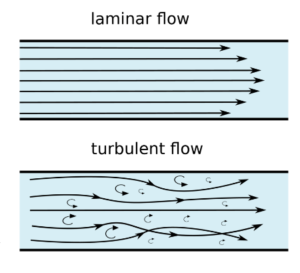
Source: CD support (https://bit.ly/3lKLpro)
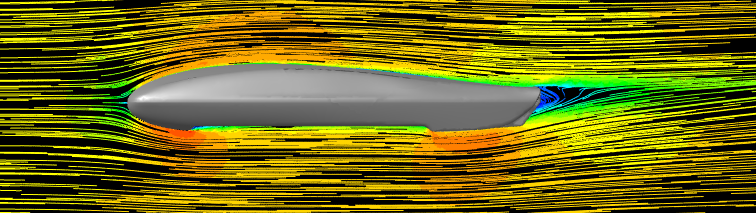
The drag coefficient (Cd) of the ASPHALTKIND roof box is just 0.11 (water-drop level), making it approximately 30% lower than that of conventional roof boxes. That might not sound like much at first. However, it’s important to note that the geometric design generates downforce rather than lift, as is the case with conventional roof boxes (or even with the extremely aerodynamic wing of an airplane). In numerical terms, at a speed of 160 km/h, the roof box presses the vehicle vertically against the road with a force of approximately 110 N (about 10 kg). By comparison, a conventional roof box pulls the vehicle slightly upward. This results in reduced traction during highway driving and thus poses an increased risk of accidents, especially on wet roads. Visually, the result can be illustrated as follows:
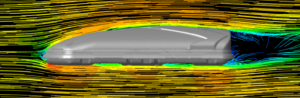
Conventional roof box with a large area of stagnant water (black spot)
Conventional roof boxes exhibit high turbulence intensity (turbulent = bad) in the rear section. This results in a large so-called dead-water zone, which occupies approximately one-third of the roof box’s length, before the airflow converges again into a laminar flow (laminar = good). Such turbulent effects negatively impact the roof box’s performance and, due to the resulting negative pressure, lead to increased fuel consumption and energy use.
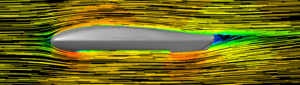
ASPHALTKIND Roof Box with a significantly smaller dead zone
The ASPHALTKIND roof box’s aerodynamic teardrop shape results in significantly less flow separation at the rear, leading to a significant reduction in fuel consumption and energy use. Overall, this results in a much more uniform flow pattern with a pronounced laminar flow. It’s almost like a penguin.
Of course, the general rule is this: Only by combining perfect aerodynamics with high stability—achieved through the use of carbon fiber—is it possible to drive a (super) sports car without compromising on speed, whether on a drive, a road trip, or even on the way to your vacation destination.